
When you're on the hunt for the best ingredients for sensitive skin, the first step is figuring out what “sensitive skin” really means. It’s not so much a formal skin type as it is a condition. Your skin's natural protective barrier has been weakened, leading to that all-too-familiar redness, itching, and dryness. The real goal isn't just to calm things down, but to choose ingredients that actively help rebuild that barrier.
What Does Sensitive Skin Actually Mean?
Picture your skin's protective barrier like a well-built brick wall. On healthy skin, the bricks (your skin cells) are neatly packed together with strong mortar (natural fats like ceramides). This wall does two crucial jobs: it keeps moisture locked in and keeps irritants like pollution and allergens locked out.
But when your skin is sensitive, that wall has developed some cracks. The mortar has weakened, letting precious moisture sneak out in a process called transepidermal water loss (TEWL). This is exactly why sensitive skin often feels constantly dry, tight, and thirsty.
At the same time, those gaps are an open invitation for outside troublemakers. Things that wouldn't normally bother your skin can now get in and trigger a reaction, leaving you wondering what went wrong.
The Telltale Signs of a Compromised Barrier
A weakened skin defense system isn't shy; it sends out clear signals. You're likely dealing with sensitive skin if you regularly notice:
- Redness and Flushing: Your skin might look blotchy or get flushed easily, especially after you wash your face or put on a new product.
- Stinging or Burning Sensations: This is a classic sign. An ingredient has slipped through the cracks and is irritating the nerve endings.
- Itchiness and Discomfort: That nagging, itchy feeling often goes hand-in-hand with dryness and irritation.
- Dry, Flaky Patches: When your skin can't hold onto moisture, you'll see the evidence in the form of rough texture and flakiness.
If this sounds familiar, you're far from alone. Studies show that about 50% of the global population says they have sensitive skin. It's a bit more common in women (~60%) than in men (~40%), which just goes to show how many of us are searching for gentle, effective solutions. You can read more about the growing sensitive skin market and its trends.
Common Triggers Behind Skin Sensitivity
So what causes those cracks in your skin's wall in the first place? It's usually a mix of things that wear down your defenses over time.
Sensitive skin isn't about being weak; it's about being highly responsive. Your skin is sending clear signals that its protective barrier needs support. The key is to listen and respond with gentle, restorative care rather than aggressive treatments.
The most common culprits include:
- Genetics: Sometimes, you're just born with a naturally less robust skin barrier.
- Environmental Factors: Harsh winds, cold snaps, blistering sun, and city pollution all chip away at your skin.
- Over-Exfoliation: Going too hard with gritty scrubs or strong chemical exfoliants can strip away those protective fats.
- Harsh Ingredients: We’ve all seen them. Products loaded with drying alcohols, sulfates, and synthetic fragrances are notorious for throwing skin off balance.
Getting this foundation right is everything. Choosing the best ingredients for sensitive skin isn’t about a temporary fix. It’s about being strategic and picking things that will patch up the holes in your skin's wall, bringing back its strength, resilience, and comfort for good.
Your Skin's Calming All-Star Ingredients
Trying to decipher skincare labels can feel like you're learning a whole new language. But when it comes to calming angry, sensitive skin, a few key players consistently rise to the top. These aren't just trendy buzzwords; they are the tried-and-true heroes that actually work with your skin to rebuild its strength and provide lasting comfort.
Think of these ingredients as a specialized repair crew for your skin's protective barrier. Each one has a very specific job, whether it's patching up cracks, reinforcing the structure, or defending it from future attacks. When they work together, the results are powerful.
This simple graphic shows exactly how genetics and the environment can gang up on your skin, leading to the redness and irritation we all know too well.
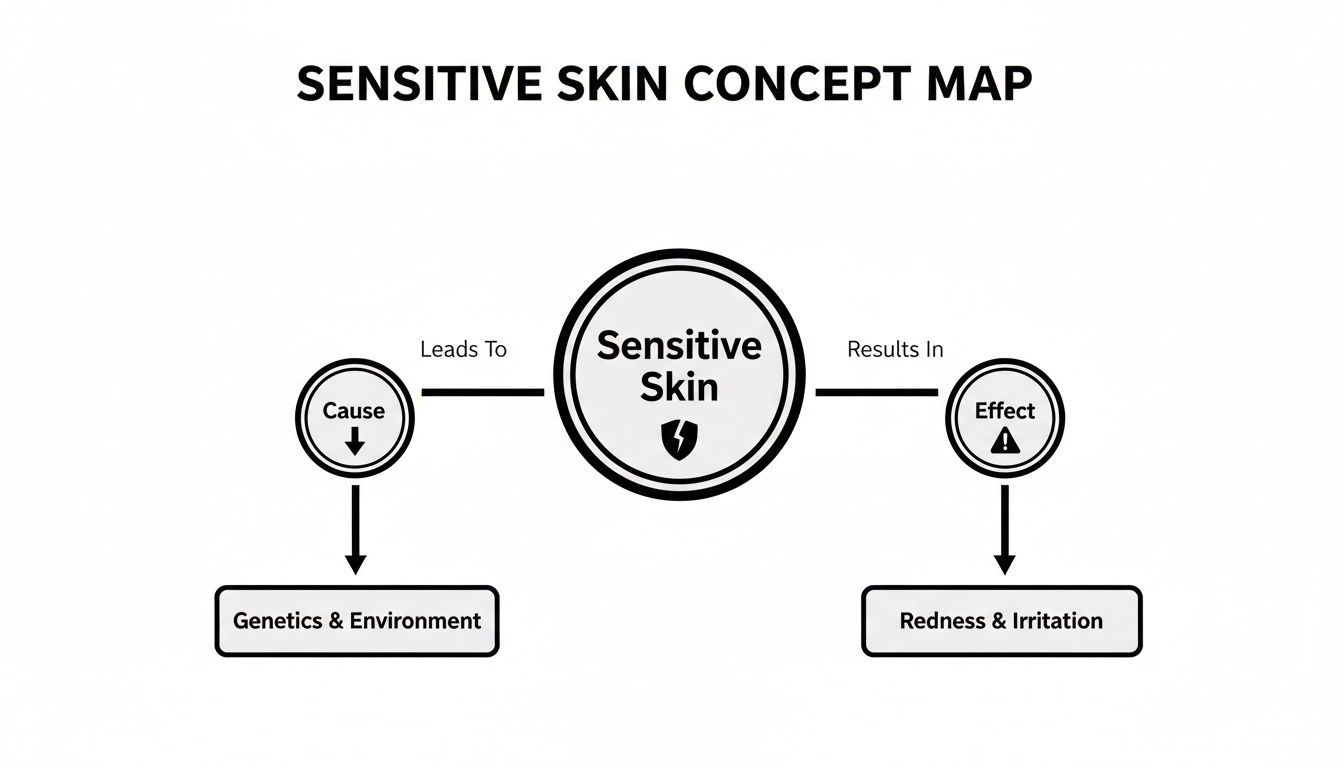
As you can see, when your skin's defenses are down, it sends out distress signals in the form of redness and discomfort. That’s your cue to bring in gentle, supportive ingredients.
Goat Milk: The Gentle Nourisher
Goat milk is so much more than just a farm-fresh trend—it's a nutritional powerhouse for delicate skin. Its magic lies in a unique composition that's remarkably similar to the natural pH of our own skin. This means it can cleanse and nourish without throwing your skin's delicate ecosystem out of whack.
It’s also packed with lactic acid, one of the kindest alpha-hydroxy acids (AHAs) around. Unlike harsh scrubs that can cause more harm than good, lactic acid gently nudges away dead skin cells while pulling in moisture, revealing a smoother, calmer complexion underneath.
At The Goats Field, we use the fresh milk from our own goats as the soothing, creamy base for our soaps and lotions. It delivers essential vitamins like A, D, and B6 directly to your skin, giving it the tools it needs to repair itself.
Colloidal Oatmeal: The Ultimate Soother
If your skin is itchy, red, and practically screaming for relief, colloidal oatmeal is your first responder. This isn't the same stuff you have for breakfast; it's oatmeal that has been finely ground and processed to draw out its most potent calming compounds, like avenanthramides.
These compounds are proven to dial down redness and inflammation, which is why oatmeal baths are a go-to for anyone dealing with an eczema flare-up. It’s like wrapping your skin in a soft, protective blanket that instantly calms the itch and forms a barrier to lock precious moisture in.
That's precisely why it's a star ingredient in our Oatmeal, Milk & Honey soap. The colloidal oatmeal and goat milk work together to provide a one-two punch of calming relief, making it one of the absolute best combinations for reactive skin.
Ceramides: The Barrier Mortar
Remember our analogy of the skin barrier being a brick wall? Well, ceramides are the mortar holding the bricks (your skin cells) together. These naturally occurring fats make up over 50% of your skin’s structure, and a strong, healthy barrier is impossible without them.
When ceramide levels dip, that wall becomes weak and leaky, letting moisture out and irritants in. Adding them back into your routine with a good lotion is like re-grouting the tile—it seals the gaps, stops the leaks, and keeps the bad stuff out.
Glycerin: The Moisture Magnet
Glycerin is a classic for a reason. It's an incredibly effective and gentle humectant, which is a fancy way of saying it's a moisture magnet. It literally pulls water vapor from the air and draws moisture up from the deeper layers of your skin to hydrate the surface.
This provides an immediate plumping and softening effect. Best of all, glycerin feels light on the skin and won't clog pores, making it a safe bet for just about every sensitive skin type out there.
The most effective sensitive skincare routines focus on a two-part strategy: first, actively soothe existing irritation with ingredients like oatmeal and goat milk, and second, rebuild the skin's own defenses with barrier-supporting components like ceramides and niacinamide.
Niacinamide: The Versatile Calming Agent
Niacinamide, a form of vitamin B3, is a true multitasking superstar in the skincare world. For sensitive skin, its biggest claims to fame are its ability to calm inflammation and get your skin barrier back in fighting shape.
Here’s how it gets the job done:
- Boosts Ceramide Production: It encourages your skin to create more of its own natural ceramides, strengthening your barrier from the inside out.
- Reduces Redness: Its powerful anti-inflammatory properties help take down visible blotchiness and calm reactivity.
- Improves Hydration: By making the barrier stronger, it helps your skin hold onto moisture more effectively over time.
This makes it a fantastic ingredient if you're dealing with sensitivity plus other issues, like an uneven skin tone.
Non-Nano Zinc Oxide: The Physical Shield
When it comes to sun protection for skin that's easily irritated, physical sunscreens are the gold standard, and non-nano zinc oxide is king. Chemical sunscreens work by absorbing UV rays and turning them into heat, which can be a major trigger for redness and discomfort.
Zinc oxide, on the other hand, acts like a physical shield. It creates a protective barrier that sits on top of your skin, reflecting and scattering those damaging UV rays away before they can even think about causing trouble. The "non-nano" part is key—it means the particles are too large to be absorbed by your skin, so they stay on the surface where you need them.
This is exactly why we formulated The Goats Field's sunscreen with non-nano zinc oxide. It delivers broad-spectrum protection you can count on, without the risk of irritation.
To make things even easier, here's a quick cheat sheet for the best ingredients to look for on your next shopping trip.
Gentle Ingredient Quick Reference Guide
| Ingredient | Primary Benefit | Works Best For | Found In The Goats Field |
|---|---|---|---|
| Goat Milk | Nourishing & pH-balancing | All sensitive skin, especially dry or eczema-prone | Soaps, Lotions, Shampoo Bar |
| Colloidal Oatmeal | Soothing & anti-itch | Extremely irritated, itchy, or eczema-prone skin | Oatmeal, Milk & Honey Soap |
| Ceramides | Barrier repair & moisture retention | Dry, compromised, or maturing skin | Daily Lotions |
| Glycerin | Hydration & moisture attraction | All skin types, especially dehydrated skin | All Soaps and Lotions |
| Niacinamide | Calming & barrier support | Red, blotchy, and reactive skin | Advanced formulation lotions |
| Non-Nano Zinc Oxide | Physical sun protection | All sensitive skin needing sun defense | Mineral Sunscreen |
With these powerhouse ingredients in your corner, you can finally stop fighting with your skin and start working with it to build a calmer, healthier, and more resilient complexion.
Common Irritants and Ingredients to Avoid
Choosing the right skincare can feel like navigating a minefield. While good ingredients help your skin thrive, a few wrong turns can quickly lead to a flare-up. Knowing what to avoid is just as crucial as knowing which are the best ingredients for sensitive skin. This isn't about being afraid of every ingredient out there; it's about becoming a savvy label-reader who can spot potential troublemakers from a mile away.
Many everyday products are packed with fillers or active ingredients that are simply too harsh for a compromised skin barrier. When your skin’s defenses are down, these substances can sneak in deeper than they should, kicking off a cycle of inflammation, redness, and that dreaded stinging feeling.
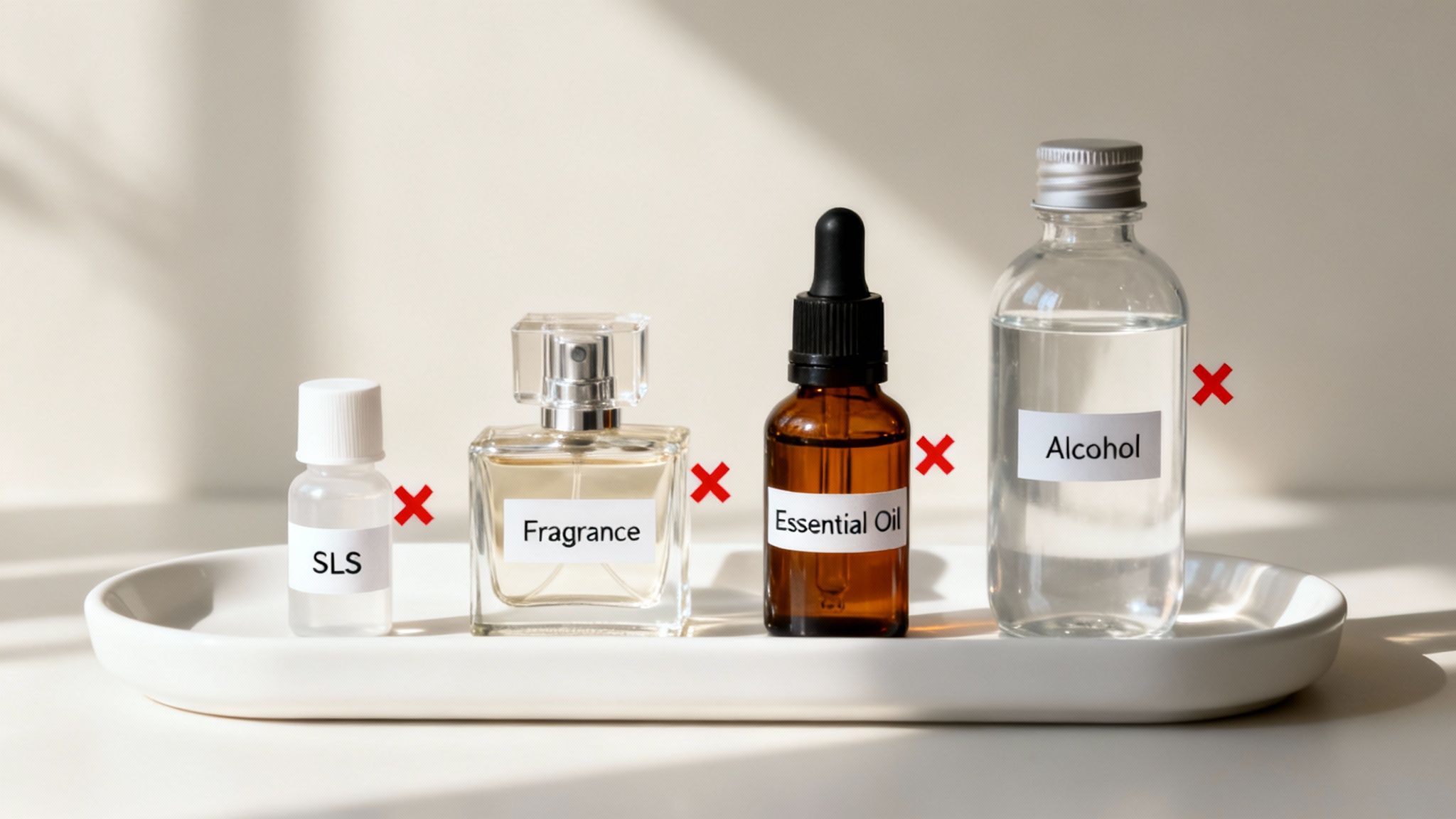
Learning to identify these culprits on an ingredient list is one of the most powerful moves you can make for your skin. Let’s break down the main offenders.
The Hidden Risk of Fragrance
If you see "fragrance," "parfum," or "perfume" on a label, think of it as a red flag. These terms are protected as trade secrets, which means companies can legally hide a cocktail of dozens, or even hundreds, of chemicals under a single name. It’s no surprise that this mystery mix is one of the top causes of skin reactions and allergic contact dermatitis.
Don't be fooled by products labeled "unscented," either. That term isn't regulated and can mean that masking fragrances have been added to hide the chemical scent of the other ingredients. To be safe, always look for products that are explicitly labeled "fragrance-free."
Harsh Sulfates That Strip Your Skin
Sulfates, especially Sodium Lauryl Sulfate (SLS) and Sodium Laureth Sulfate (SLES), are the detergents that give many cleansers, body washes, and shampoos that super-rich, bubbly lather. While it might feel like you're getting a deep clean, that foam comes at a price.
These ingredients are so good at their job that they strip away not just the dirt, but also your skin's natural, protective oils. This leaves your skin barrier exposed and vulnerable. For sensitive skin, it’s like using a power washer on a delicate painting—it damages the very thing you're trying to protect, leading to that tight, dry, and irritated feeling. That's exactly why our Shampoo Bars are made without any harsh sulfates.
Your skin should never feel "squeaky clean." That tight, pulled sensation is a major sign that your protective lipid barrier has been compromised, leaving it wide open to irritation and moisture loss.
Drying Alcohols to Avoid
Not all alcohols in skincare are bad news. Some, like cetyl and stearyl alcohol, are fatty alcohols that are actually good for moisturizing. The ones you need to watch out for are the simple, drying alcohols that often appear near the top of an ingredient list.
Keep an eye out for these:
- Alcohol Denat (Denatured Alcohol)
- SD Alcohol
- Isopropyl Alcohol
- Ethanol
They’re often included to make a thick cream feel lighter on the skin or to help other ingredients absorb better. The problem is, they evaporate in a flash, taking your skin's natural moisture with them and weakening its protective barrier over time.
Why Some Essential Oils Cause Trouble
While essential oils come from plants and many have fantastic benefits, "natural" doesn't always mean "gentle." They are highly concentrated, and their natural fragrances are made up of powerful compounds that can be very irritating for reactive skin.
Oils from citrus fruits (like lemon and bergamot), mint (peppermint), and some flowers (lavender, tea tree) are common culprits. They can trigger redness, itching, and even photosensitivity, which makes your skin more susceptible to sun damage. Unless you already know for a fact that your skin gets along with a specific essential oil, it’s usually safer to steer clear.
Chemical Sunscreens Versus Physical Blockers
There are two main types of sunscreen, and they work in completely different ways. Chemical sunscreens absorb into the skin, where they soak up UV radiation and convert it into heat. That chemical reaction is often what causes stinging and flushing in sensitive skin. Common chemical filters like oxybenzone, avobenzone, and octinoxate are frequently tied to allergic reactions.
Physical sunscreens, on the other hand, use minerals that create a shield on top of your skin to physically block and reflect UV rays away. This gentle mechanism is why formulas with non-nano zinc oxide or titanium dioxide, like The Goats Field sunscreen, are the gold standard for protecting sensitive complexions without causing a flare-up.
How to Read Skincare Labels with Confidence
Walking down the skincare aisle can feel like preparing for a chemistry test. Those long ingredient lists, officially called INCI (International Nomenclature of Cosmetic Ingredients), are confusing, to say the least. But learning to crack that code is the single best thing you can do to protect your sensitive skin.
Think of an ingredient list like a recipe—the most important stuff always goes in first. It's called the “rule of concentration,” and it's your secret weapon. Brands are required to list ingredients from the highest concentration down to the lowest.
So, if a product shouts about calming Colloidal Oatmeal on the front, but you find it hiding at the very bottom of the list? Its actual impact is probably tiny. The first five to seven ingredients are the ones doing most of the heavy lifting.
The One Percent Rule and Beyond
Once you get past the main players, there’s another handy guideline: the “1% line.” Any ingredient making up less than 1% of the formula can be listed in any order the brand wants.
This is where you’ll typically find preservatives, potent extracts, and fragrance bits. It means an ingredient listed dead last isn't necessarily the least concentrated of all—it just means it's at 1% or less. This little insight helps you manage your expectations and spot potential red flags hiding in the fine print.
Understanding this top-down structure changes everything. You stop being a passive shopper and become an empowered advocate for your own skin, able to look past the pretty packaging and see what’s really inside.
This shift is happening everywhere. Natural and organic ingredients are taking over the sensitive skincare world, with about 50% of the market now focused in this direction. This boom is driven by smart shoppers like you—between 52-54% actively search for clean, simple ingredient lists to avoid known irritants. For the 415 million people worldwide dealing with rosacea, making this switch to natural alternatives has been shown to cut down flare-ups by an incredible 45%. Find out more about the sensitive skin care market trends.
Translating Common Marketing Claims
Of course, the front of the bottle is a minefield of its own, covered in buzzwords designed to grab your attention. Some are useful, but others can be downright deceptive. Here’s a quick rundown of what they actually mean:
- Hypoallergenic: This just means the product is less likely to cause an allergic reaction, not that it's impossible. The term isn't regulated, so one brand's definition can be totally different from another's.
- Dermatologist-Tested: All this means is a dermatologist checked the product for skin tolerance, usually on a small group of people. It doesn’t mean it’s dermatologist-recommended or endorsed. It's a subtle but important difference.
- Fragrance-Free vs. Unscented: This is a big one. "Fragrance-free" is what you want—it means no fragrances, synthetic or natural, were added. "Unscented" often means chemical masking agents have been thrown in to hide the smell of the other ingredients, and those can be just as irritating. Always, always go for fragrance-free.
At The Goats Field, we’re all about radical transparency. We keep our labels simple and put our powerhouse ingredients like Goat Milk and Non-Nano Zinc Oxide right where you can see them. We believe this clarity is key to helping you make confident, skin-safe choices.
Building Your Gentle And Effective Skincare Routine
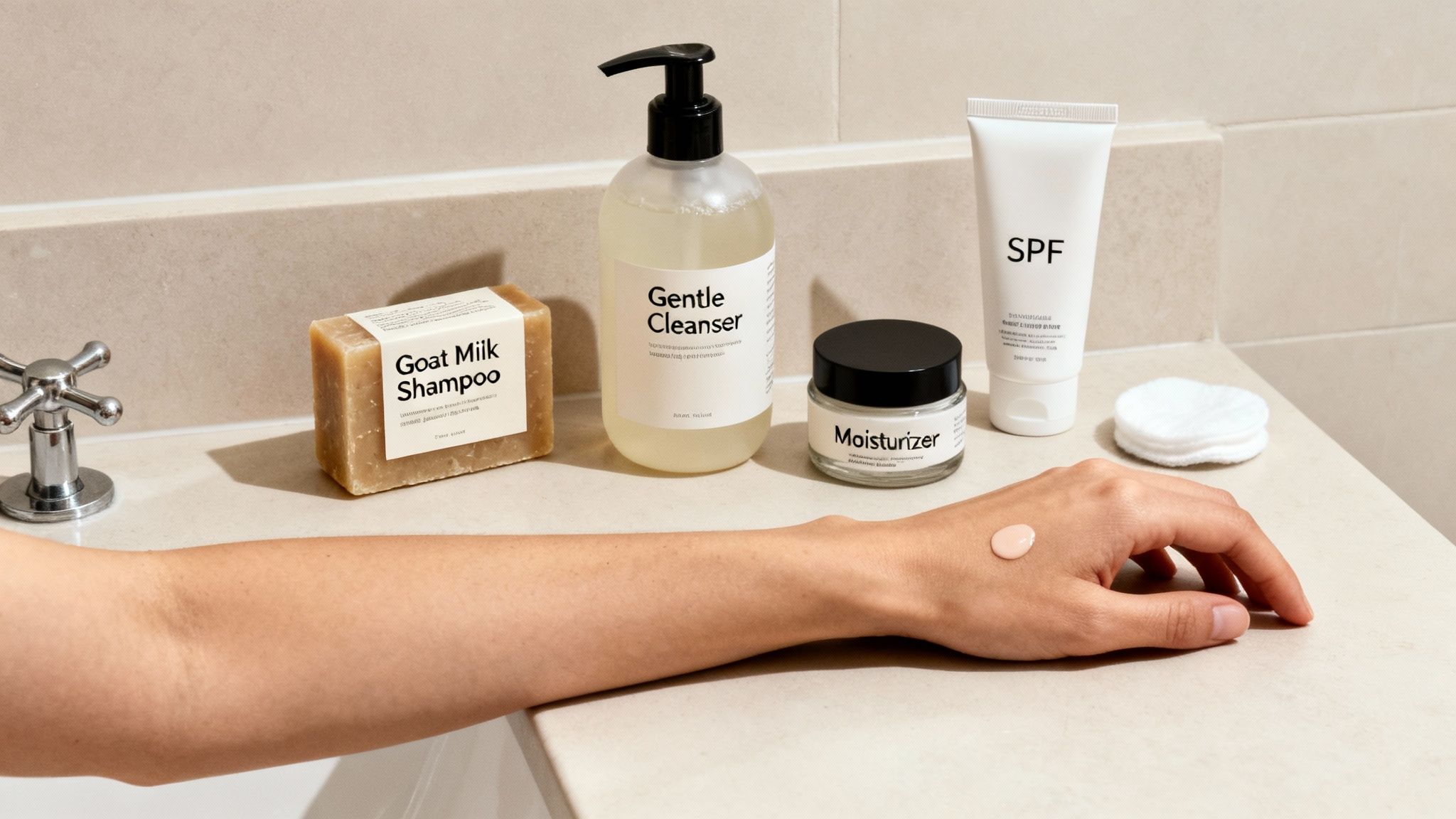
Knowing the best ingredients for sensitive skin is a great start, but now it's time to put them into practice. Creating a routine that actually works isn't about cluttering your counter with a dozen different bottles. For sensitive skin, less is almost always more.
The secret is a simple, consistent framework built on three core pillars: cleansing, moisturizing, and protecting. Think of it like building a house—if the foundation isn't solid, anything you add on top is just going to crumble. Your goal is a daily ritual that calms irritation, strengthens your skin’s barrier, and stops flare-ups before they start.
The First Pillar: Cleansing Gently
How you wash your face, body, and hair really sets the tone for your entire routine. The wrong cleanser can strip your skin of its natural oils, instantly weakening its defenses and leaving it feeling tight, dry, and angry. But the right one cleans away grime while respecting that delicate skin barrier.
Your mission here is to ditch cleansers with harsh sulfates like SLS and SLES. Instead, look for formulas that lean on gentle, nourishing ingredients to get the job done.
For a sensitive scalp, for instance, something like The Goats Field’s Shampoo Bar is a perfect swap. Traditional shampoos are often loaded with stripping detergents, but our bar uses the natural cleansing power of goat milk to lift away impurities without causing dryness or itchiness. This same idea applies to your whole body—a soothing soap bar can bring relief from head to toe.
The Second Pillar: Moisturizing To Restore
Once your skin is clean, the next move is to lock in hydration and kickstart the repair process. This is where a top-notch moisturizer becomes your best friend. A truly great moisturizer for sensitive skin does more than just slap on some temporary moisture; it delivers key ingredients that actively rebuild and reinforce your skin's protective barrier.
You want to see a smart combination of soothing and repairing ingredients on the label. A great lotion should have:
- Humectants: Ingredients like glycerin that pull moisture into the skin.
- Emollients: Things like goat milk cream that smooth and soften the skin’s surface.
- Occlusives: Components like shea butter that create a light seal to stop moisture from escaping.
- Repairing Agents: Heroes like ceramides and niacinamide that help patch up the little cracks in your skin barrier.
Our daily lotions are formulated with this exact multi-pronged approach in mind, delivering serious hydration and barrier support in a lightweight formula that never feels greasy. The goal is to leave your skin feeling soft and comfortable, not sticky.
The Third Pillar: Protecting From Triggers
The final, non-negotiable pillar of your core routine is daily protection. And for skin, that almost always means sunscreen. Sun exposure is one of the biggest triggers for inflammation and redness in sensitive skin types. Even on cloudy days, those UV rays are working away at your skin’s defenses.
As we covered earlier, physical sunscreens are the way to go for reactive skin. Chemical filters can generate heat and cause irritation, while physical blockers create a gentle shield. Look for a formula with non-nano zinc oxide, which provides broad-spectrum protection by sitting right on top of your skin to reflect harmful rays away.
Think of your routine as a simple, three-step promise you make to your skin every day. First, you promise to gently cleanse it without causing harm. Second, you promise to restore its moisture and strength. And third, you promise to protect it from the outside world. Consistency with this simple promise is far more powerful than any complicated, 10-step regimen.
Now that we have the pillars, let's look at a sample blueprint for putting it all together.
Sensitive Skin Routine Blueprint
Here’s a practical example of what a simple, effective daily routine could look like using products built for sensitive skin.
| Step | Morning Routine | Evening Routine | Key Ingredient Focus | The Goats Field Example |
|---|---|---|---|---|
| 1. Cleanse | Gently wash face and body with lukewarm water. | Wash away the day's grime, makeup, and sunscreen. | Goat Milk, Colloidal Oatmeal | Goat Milk Soap Bar |
| 2. Moisturize | Apply a calming lotion to damp skin to lock in hydration. | Apply a richer layer of lotion to support overnight repair. | Ceramides, Niacinamide, Glycerin | Daily Goat Milk Lotion |
| 3. Protect | Apply a physical sunscreen as the final step. | (Not needed) | Non-Nano Zinc Oxide | SPF 30 Mineral Sunscreen |
| Special Care | (As needed) | (As needed) | Goat Milk, Natural Oils | Shampoo Bar for sensitive scalp |
This table is just a starting point. The key is finding what feels best for your skin and sticking with it consistently.
The Golden Rule: Patch Test Everything
Even with the safest ingredients, everyone’s skin is unique. A product that’s a holy grail for one person might not agree with another. This is precisely why patch testing is a non-negotiable step before you welcome anything new into your routine.
It’s a simple, foolproof way to check for a bad reaction before you slather a product all over your face or body. Here’s how to do it right:
- Choose a Discreet Spot: Apply a small dab of the new product to a hidden but sensitive patch of skin, like the inside of your wrist, behind your ear, or on your inner elbow.
- Wait and Observe: Leave the product on for at least 24 hours. Try not to wash the area if possible.
- Check for Reactions: After 24 hours (or up to 72 if you're extra sensitive), check the spot for any signs of redness, itching, burning, or bumps.
- Proceed with Confidence: If the area is calm and clear, you can feel much more confident about introducing the product to the rest of your skin.
This quick safety check can save you from days or even weeks of dealing with a widespread reaction. It’s a tiny investment of time that pays off in a big way, making sure your skincare journey is a calm and happy one.
Common Questions About Sensitive Skincare
Even when you feel like you have all the right info, dealing with sensitive skin can still feel a bit like guesswork. It’s totally normal to have questions pop up as you try to nail down a routine that actually makes your skin happy. Let’s tackle some of the most common ones to give you clear, straightforward answers.
Think of this as your quick-reference guide. We’ll clear up any lingering confusion and help you feel even more confident in the choices you're making for your skin.
Can I Use Actives Like Vitamin C Or Retinol?
Yes, but the golden rule here is to move very, very slowly. If you're going to try powerful ingredients like Vitamin C or retinol, start with the lowest possible concentration and only use it once or twice a week. Look for gentler versions, like encapsulated retinol or a mild Vitamin C derivative like Sodium Ascorbyl Phosphate, which are known to be less irritating.
Here's a great pro-tip: apply your active after your moisturizer. This simple step creates a buffer between the active and your skin, which can dramatically cut down on potential redness or stinging. If your skin is extremely reactive, or if you're managing eczema or rosacea, your safest bet is always to chat with a dermatologist first.
Is Natural Or Organic Always Better?
Not always, and this is a big one. While many of the best ingredients for sensitive skin come straight from nature—like our beloved goat milk and colloidal oatmeal—other natural ingredients can be serious troublemakers. Potent essential oils, especially from citrus or tea tree, are common culprits that can easily trigger a flare-up.
The words ‘natural’ and ‘organic’ aren’t strictly regulated in the skincare world. This means a scientifically formulated product with proven soothers like ceramides might actually be a safer bet for you than a 'natural' product loaded with potential allergens. Always trust the ingredient list over the marketing buzzwords.
How Long Does It Take To See Results?
When you introduce a new product, the first 24 to 72 hours are all about watching for a bad reaction. This is exactly why patch testing is a non-negotiable step for anyone with sensitive skin.
If your skin gives the all-clear, you’ll want to give the product at least four to six weeks to see real, positive changes. It takes about a month for your skin to go through a full cell turnover cycle. Ingredients meant to repair your skin's barrier or calm inflammation need that consistent time to truly work their magic. But if you feel any persistent stinging or notice more redness, stop using it right away.
At The Goats Field, we believe the best skincare is simple, honest, and built on nature’s kindest ingredients. Explore our collection of goat milk skincare and build a routine that truly calms, nourishes, and protects your sensitive skin. Discover gentle care at The Goats Field.