
If you’re stuck in a frustrating cycle of slathering on heavy creams only to feel that familiar tightness creep back in just a few hours, you're not alone. The real problem often isn't just a lack of moisture; it's a damaged skin barrier that can't hold on to hydration. This is where switching to natural skincare for dry skin can be a total game-changer.
Natural skincare isn't about slapping on temporary fixes. It’s about using gentle, plant-based ingredients to rebuild your skin's defenses, soothe irritation, and provide deep, lasting hydration. Instead of harsh chemicals that strip your skin, alternatives like shea butter, jojoba oil, and goat milk work with your skin to bring it back into balance. The result? Real relief and a comfortable, healthy glow.
Why Natural Ingredients Soothe Dry Skin
Think of your skin barrier like a sturdy brick wall. Your skin cells are the bricks, and the lipids—your skin’s natural fats and oils—are the mortar holding it all together. A strong, intact wall keeps moisture locked in and irritants locked out. But harsh chemicals, environmental stress, and synthetic ingredients can wear away that mortar, leaving your skin's defenses full of holes.
Rebuilding Your Skin's Defenses
This is where natural ingredients really shine. Many are biocompatible, which is just a fancy way of saying their structure is similar to the lipids already in your skin. Because of this, they can integrate seamlessly, patching up the gaps in that protective wall.
The best skincare routine is one that supports your skin’s natural barrier and addresses your core needs—nothing more. The goal is to work in harmony with your skin, not against it.
Instead of just sitting on the surface, ingredients like goat milk, which is packed with fatty acids and vitamins, can sink in deep to nourish and reinforce this barrier from the inside out. This helps your skin become more resilient and better at holding onto moisture all on its own, finally breaking the cycle of chronic dryness.
Calming Irritation and Restoring Comfort
Dry skin often goes hand-in-hand with sensitivity, redness, and inflammation. Unfortunately, many conventional products contain fragrances, sulfates, and alcohols that only make things worse. A well-designed natural skincare routine for dry skin sidesteps these common triggers entirely.
Gentle, soothing botanicals are the heroes here:
- Goat Milk: It offers lactic acid for gentle exfoliation and a high-fat content that soothes and moisturizes without a hint of irritation.
- Oatmeal: Famous for its anti-inflammatory properties that can calm down redness and itchiness almost instantly.
- Honey: A natural humectant that literally pulls moisture into the skin while providing gentle antibacterial benefits.
By focusing on ingredients that calm, nourish, and rebuild, you’re not just putting a temporary band-aid on the symptoms. You're building a foundation for healthier, more comfortable skin for the long haul. This guide is your roadmap to understanding these powerful natural allies and creating a routine that finally brings you relief.
Understanding How Natural Ingredients Work
If you really want to heal dry skin, you have to look past the quick fixes and get a feel for what’s happening on a deeper level. The best natural skincare for dry skin isn’t about some single magic ingredient; it’s about a team of ingredients working in harmony to rebuild, hydrate, and protect your skin. Think of it like putting together a specialized crew, where each member has a unique job to do.
These specialists generally fall into three main groups. Once you know what they are and how they work, you can start reading ingredient labels like a pro and pick products that genuinely support your skin barrier.
The Three Pillars of Natural Hydration
First up in our hydration crew are humectants. Picture these as tiny moisture magnets. Ingredients like honey and glycerin literally pull water vapor from the air and draw it into the top layers of your skin. This delivers a direct dose of hydration right where you need it most.
Next, we have the emollients. If you think of your skin barrier as a brick wall, emollients are the mortar holding everything together. Natural ingredients like shea butter, jojoba oil, and the fatty acids found in goat milk are fantastic emollients. They work by filling in the microscopic cracks between your skin cells, which smooths out texture, softens roughness, and makes your skin feel instantly more comfortable.
Finally, we have the protectors of the group: occlusives. Ingredients like beeswax and certain plant oils form a very thin, breathable film over your skin's surface. This shield doesn’t suffocate your skin. Instead, it acts like a lid on a pot of water, preventing all that good moisture from the humectants and emollients from just evaporating away. This process is known as reducing transepidermal water loss (TEWL), a huge factor in keeping dry skin happy all day.
This image really helps visualize how these three pillars work together to get your skin barrier back on track.
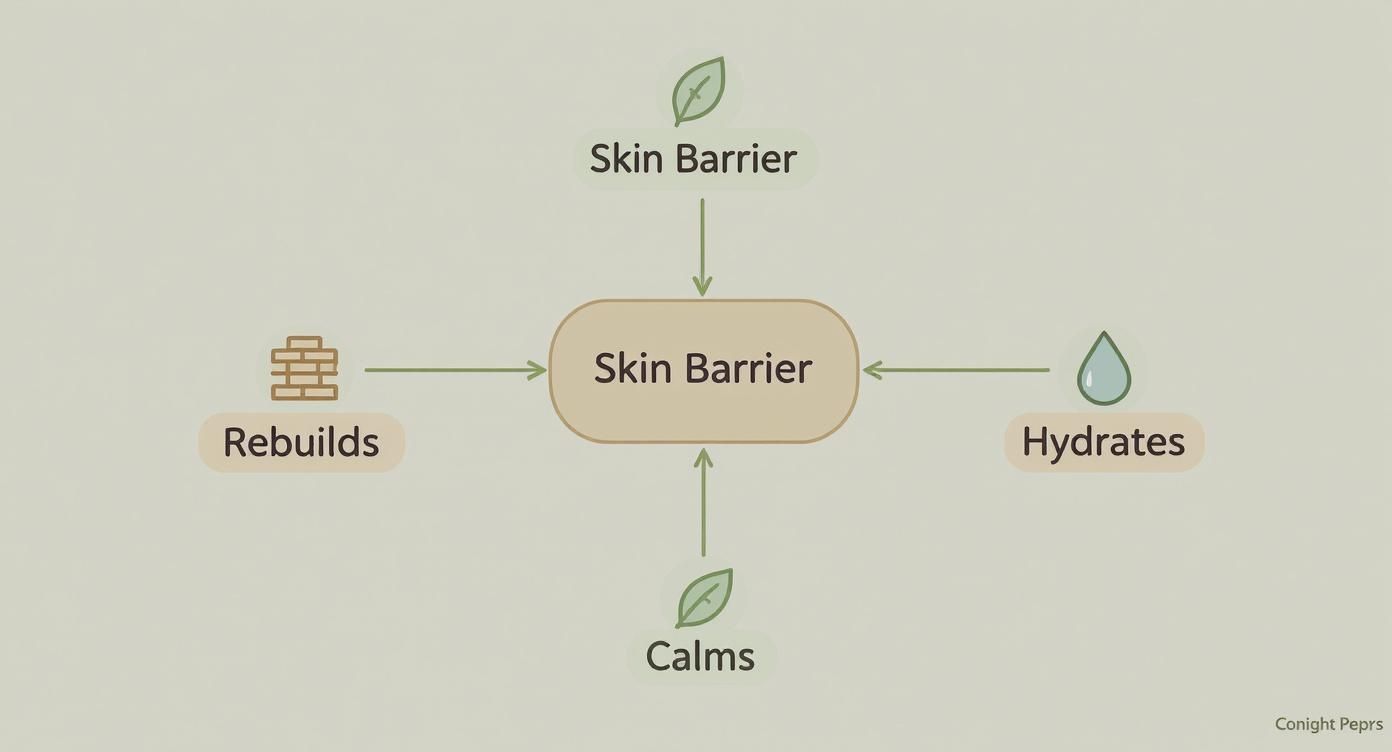
As you can see, a healthy skin barrier isn’t just about slathering on one thing. It’s a dynamic system that needs support in a few key areas to repair its structure and hold onto moisture.
Why Knowing Your Ingredients Matters
This team-based approach is exactly why so many people with dry, sensitive skin are making the switch to natural products. They're looking for formulas that are not only effective but also transparent. A 2025 industry survey really drove this home, showing that 59% of consumers now prefer natural or organic skincare, while 52% actively look for clean, recognizable ingredient lists. For anyone dealing with dry skin, this shift is a big deal because it means avoiding harsh synthetic ingredients that can weaken an already fragile skin barrier.
A truly effective natural skincare product for dry skin won't just have one type of ingredient. It will feature a thoughtful blend of humectants, emollients, and occlusives that work together to deliver complete hydration and barrier repair.
Understanding this synergy is everything. When you see a product that features both honey (a humectant) and shea butter (an emollient), you know the person who made it understands how to both deliver moisture and help your skin keep it. It's also vital that these formulas stay pure without synthetic junk. To get a better handle on how brands keep products fresh and stable naturally, it's worth reading up on the role of natural preservatives.
Ultimately, when you can spot these key ingredient types and know what they do, you empower yourself. You can move beyond the marketing hype and choose products based on the science of what your dry skin actually needs to thrive.
Here is a quick reference table breaking down some of the best natural ingredients for dry skin and what they do.
| Ingredient | Type (Humectant, Emollient, Occlusive) | Primary Benefit |
|---|---|---|
| Goat Milk | Emollient | Rich in fatty acids that repair the skin barrier and soothe irritation. |
| Honey | Humectant | Draws moisture from the air into the skin for deep hydration. |
| Shea Butter | Emollient & Occlusive | Fills in skin cracks for a smooth feel and helps lock in moisture. |
| Jojoba Oil | Emollient | Mimics the skin's natural sebum, softening and conditioning without clogging pores. |
| Glycerin | Humectant | A powerful moisture magnet that pulls water into the outer layer of the skin. |
| Beeswax | Occlusive | Forms a protective, breathable barrier to prevent moisture loss (TEWL). |
| Avocado Oil | Emollient & Occlusive | Deeply nourishes with vitamins and fatty acids while sealing in hydration. |
This table can be your cheat sheet when you're checking labels. By looking for a mix of these different types, you can find a product that offers the comprehensive care your dry skin is craving.
Building Your Daily Natural Skincare Routine
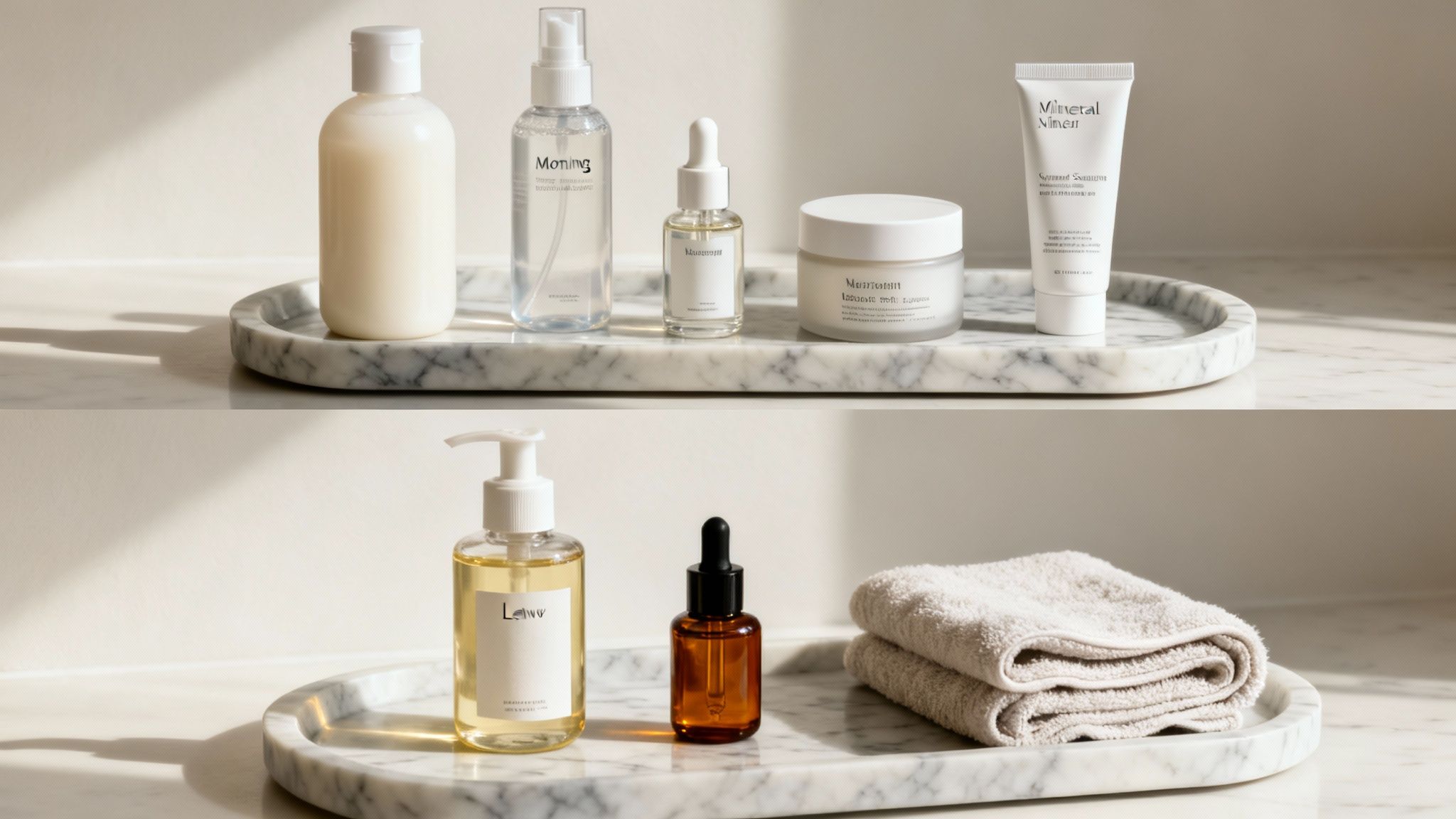
Knowing which ingredients your skin loves is a fantastic start, but the real magic happens when you turn that knowledge into a consistent habit. A daily routine for dry skin doesn't need to be a complicated, 12-step affair. It should be a simple, soothing ritual that has two main jobs: protecting your skin during the day and repairing it while you sleep.
Think of it like having two different crews working on your skin. The morning crew is all about defense, shielding your skin from the sun, wind, and pollution. The night crew handles recovery, giving your skin the nutrients it needs to rebuild overnight.
This approach ensures your skin gets exactly what it needs, right when it needs it, helping you build a stronger, happier skin barrier over time.
Your Morning Routine for Protection
The whole point of your morning routine is to hydrate your skin and protect its fragile barrier from everything the day might throw at it. Every step should be gentle and focused on adding moisture, not stripping it away.
Here’s a simple, effective game plan:
- Gentle Cleanse: Start your day with a milky, creamy, or oil-based cleanser. These formulas clean your skin without messing with its natural lipid layer. Steer clear of foaming cleansers with sulfates—they’re usually way too harsh for a dry complexion.
- Hydrating Toner or Essence: Right after cleansing, while your skin is still a little damp, pat on a hydrating toner. Look for alcohol-free options with ingredients like glycerin or honey to draw in that first layer of moisture.
- Nourishing Serum: This is where you bring in the specialists. A serum with hyaluronic acid can give your skin a serious hydration boost, while one with niacinamide can help strengthen that all-important skin barrier.
- Rich Moisturizer: This step is absolutely non-negotiable. Grab a cream-based moisturizer that's rich in emollients like shea butter or ceramides. This will soften your skin and lock in all the hydration from the previous steps.
- Mineral Sunscreen: Always finish with a broad-spectrum mineral sunscreen of at least SPF 30. Mineral sunscreens, which use zinc oxide or titanium dioxide, are typically much better tolerated by sensitive, dry skin than chemical ones.
Your Evening Routine for Repair
At night, your skin flips the switch from defense mode to regeneration mode. Your evening routine should support this natural process by washing away the day's grime and delivering deep nourishment to help with repairs.
The steps look a lot like your morning routine, but with a focus on replenishment:
- Step 1 Cleanse: If you wear makeup, start with an oil-based cleanser to melt it all away, then follow up with your gentle milky cleanser. This two-step process, known as double cleansing, gets your skin perfectly clean without that tight, stripped feeling.
- Step 2 Toner/Essence: Just like in the morning, apply a hydrating toner to damp skin to prep it for what’s next.
- Step 3 Serum: Use the same hydrating serum from your morning routine, or switch to one with gentle restorative ingredients.
- Step 4 Moisturizer: Slather on a generous layer of your favorite rich moisturizer to comfort your skin.
- Step 5 Facial Oil (Optional): For an extra dose of nourishment, finish with a few drops of a facial oil like jojoba or rosehip seed oil. This acts like a final seal, locking everything in and preventing moisture loss while you sleep.
A consistent daily routine is the bedrock of effective natural skincare for dry skin. It’s not about finding an overnight miracle but about giving your skin steady, gentle support so it can heal and strengthen itself.
This shift toward gentle, natural care is part of a much bigger trend. The global natural and organic personal care market is expected to jump from an estimated US$28.4 billion in 2025 to US$54.3 billion by 2032. This boom is driven by people just like you, searching for effective, non-irritating solutions for things like dry skin. You can discover more about this growing market and its drivers.
The Goat Milk Advantage in Your Routine
One ingredient that slots perfectly into a routine for dry, sensitive skin is goat milk. Its unique makeup makes it fantastic for both cleansing and moisturizing.
Goat milk is naturally loaded with:
- Lactic Acid: This is a very gentle alpha-hydroxy acid (AHA) that helps dissolve dead skin cells without the harshness of other exfoliants. It leaves your skin looking brighter and helps your other products sink in better.
- Fatty Acids: The high concentration of fatty acids, like capric and caprylic acid, helps repair the skin's lipid barrier, which in turn reduces that tight, flaky feeling.
- Vitamins and Minerals: It contains Vitamin A, which helps with skin cell turnover, and selenium, a mineral known for its antioxidant properties.
Using a goat milk-based cleanser or moisturizer, like the ones from The Goats Field, can deliver both soothing and restorative benefits. It's an ideal choice for simplifying your routine while giving your skin exactly what it craves.
Weekly Rituals to Boost Skin Hydration
A solid daily routine is the foundation for healthy skin, but adding a couple of weekly rituals can take things to the next level. Think of it this way: your daily routine provides your skin's essential meals, while weekly treatments are like a targeted, high-potency supplement. They go beyond managing dryness to help you achieve a truly hydrated, radiant glow.
These rituals are all about two key actions: gently clearing away the old to make way for the new, and then delivering an intense surge of nourishment. By adding a gentle exfoliation session and a deep hydration mask once or twice a week, you're supercharging your daily efforts and helping your skin barrier function at its absolute best.
Gentle Exfoliation The Right Way
For anyone with dry skin, the word "exfoliation" can sound pretty scary. Many of us have tried those harsh, gritty facial scrubs in the past, only to be left with skin that's red, irritated, and even drier than before. That happens because aggressive scrubbing can physically tear the delicate structure of your skin barrier, making moisture loss even worse.
The key is to ditch the physical scrubs and embrace gentle chemical or enzymatic exfoliants instead. These work by dissolving the "glue" holding dead skin cells to the surface, allowing them to be rinsed away without any damaging friction.
The goal of exfoliation isn't to scrub your skin into submission. It's to gently lift away the dull, flaky layer so that your hydrating products can penetrate more effectively and do their job.
Some of the best gentle options include:
- Lactic Acid: Found naturally in goat milk, this is one of the mildest alpha-hydroxy acids (AHAs). It exfoliates while also having humectant properties, which means it actually helps your skin attract and hold onto moisture.
- Fruit Enzymes: Ingredients like papain (from papaya) and bromelain (from pineapple) gently nibble away at dead skin cells on the surface. They're incredibly effective yet mild enough for most sensitive skin types.
Deep Hydration With Natural Masks
After gently exfoliating, your skin is perfectly prepped to soak up a concentrated dose of moisture. This is the perfect time for a hydrating mask, a treatment that goes far beyond your daily moisturizer to deliver rich nutrients and lipids.
While there are fantastic professionally formulated masks out there, you can also whip up powerful treatments using ingredients right from your kitchen. A good DIY mask is a cornerstone of any natural skincare for dry skin routine. The trick is to use fresh ingredients and focus on what your skin craves most: healthy fats, moisture-drawing humectants, and calming agents.
Here's a simple, effective recipe you can try at home:
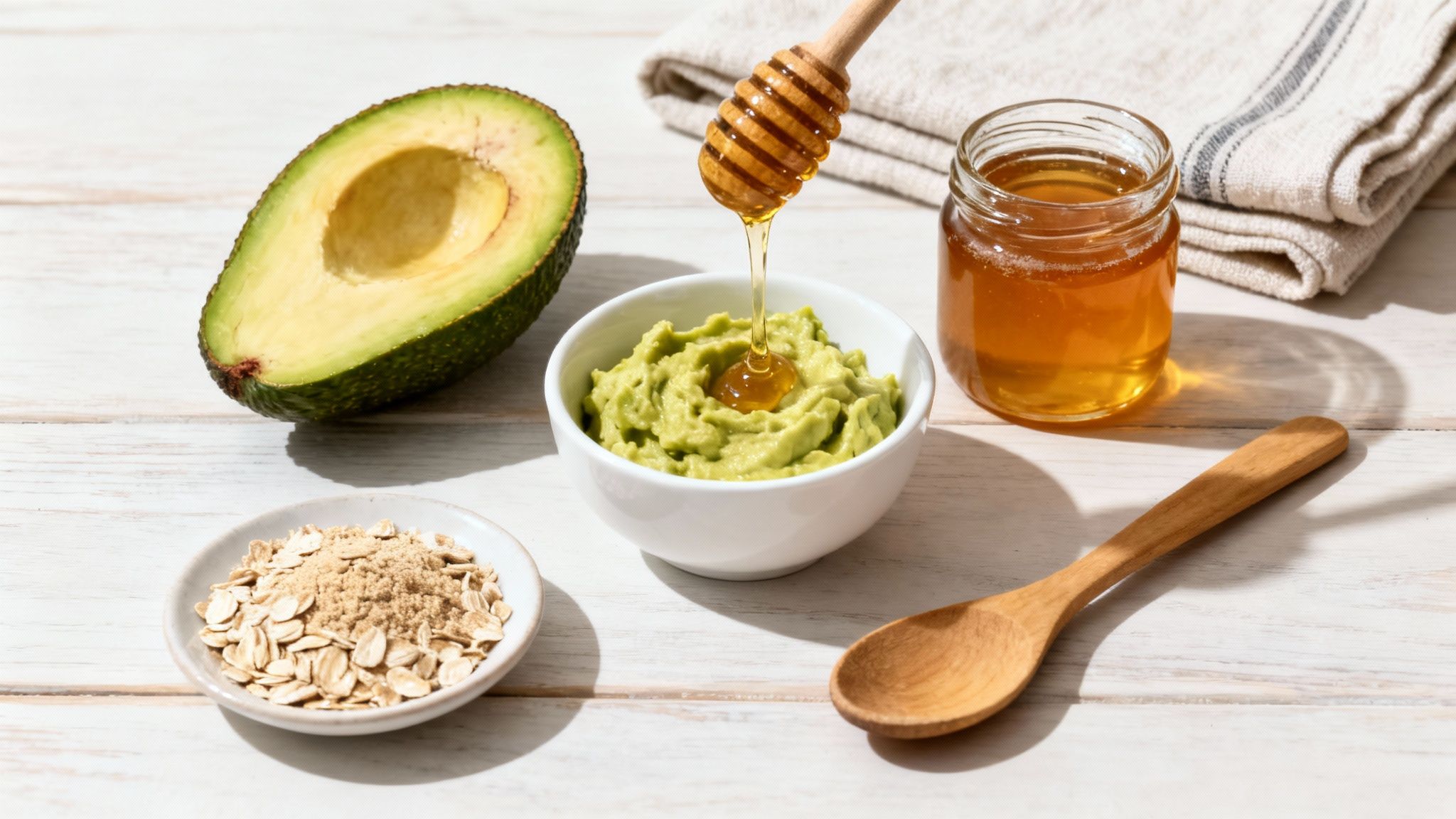
The Ultimate Soothing Hydration Mask
- 1/4 Ripe Avocado: Mash it up well. The healthy fats and Vitamin E are deeply nourishing and work to replenish your skin's lipid layer.
- 1 Teaspoon Raw Honey: A natural humectant that draws moisture into the skin, honey also has wonderfully gentle calming properties.
- 1 Tablespoon Ground Oatmeal: Oatmeal is a renowned soothing ingredient that helps reduce redness and calm down irritation.
Mix these ingredients into a smooth paste, apply to clean skin, and let it sit for 15-20 minutes before rinsing with lukewarm water. Your skin will feel noticeably softer, calmer, and more plump.
Now, while DIY masks are wonderful, it's also important to be realistic. If your skin is extremely reactive, prone to allergies, or if you have a condition like eczema, a professionally formulated product is often a safer bet. These products are created in sterile environments and have been stability-tested to ensure they are free from harmful bacteria, making them a much more reliable choice for compromised skin.
Harmful Ingredients Dry Skin Should Avoid
Figuring out what to put on your skin is only half the battle. Just as critical is knowing what to keep far, far away. Lots of popular skincare products hide ingredients that might work for some people but can be a total disaster for a dry, fragile skin barrier. They act like little wrecking balls, tearing down all the good work your nourishing products are trying to do.
Think about it like this: you wouldn't fix a leaky bucket by poking more holes in it, right? In the same way, you can't heal dry skin by slathering on ingredients that strip away its natural oils and cause even more damage. Becoming a savvy label-reader is one of the most powerful things you can do for your skin. Here’s a look at the most common culprits to watch out for.
The Stripping Surfactants
Surfactants are the reason your cleansers get that satisfying, bubbly foam. While they’re great at lifting away dirt and oil, some are way too aggressive for dry skin. They strip away the vital lipids that hold your skin barrier together.
The main ones to watch out for are Sulfates (SLS & SLES). Sodium Lauryl Sulfate and Sodium Laureth Sulfate are potent detergents that might leave your skin feeling squeaky clean, but they also leave it tight, irritated, and desperately thirsty.
- Gentle Natural Alternative: Hunt for cleansers made with mild, coconut-based surfactants like Coco-Glucoside. Or, even better, try cream-based cleansers that use nourishing oils and milks, like goat milk, to clean your skin without stripping it bare.
Dehydrating Alcohols to Avoid
Not all alcohols in skincare are bad news. The ones you need to sidestep are the simple, short-chain types that evaporate in a flash. They might make a product feel light and help other ingredients sink in, but they take your skin's precious moisture along for the ride.
When a product with drying alcohols evaporates off your skin, it messes with your delicate acid mantle. This instant degreasing effect can trick your skin into producing more oil to make up for it, kicking off a frustrating cycle of irritation and dehydration.
Keep an eye out for these on an ingredient list:
- SD Alcohol
- Denatured Alcohol
- Isopropyl Alcohol
- Ethanol
These are especially damaging when they show up in toners and moisturizers—products that are supposed to be adding hydration, not stealing it.
- Gentle Natural Alternative: Instead, look for products that use fatty alcohols like Cetyl Alcohol or Stearyl Alcohol. These are waxy, non-irritating ingredients that actually help condition and soften your skin.
Other Common Irritants
Beyond sulfates and certain alcohols, a few other common ingredients can spell trouble for a dry, sensitive complexion.
Synthetic Fragrances: This is a big one. Often listed simply as "fragrance" or "parfum," this innocent-looking term can conceal a cocktail of hundreds of different chemicals. These are one of the most common triggers for allergic reactions and irritation. For any natural skincare for dry skin routine, skipping them is non-negotiable.
Mineral Oil and Petrolatum: While these ingredients are heavy-duty at sealing in moisture, they come from petroleum and can form a thick, non-breathable barrier on the skin. Some people find they clog their pores and much prefer plant-based occlusives that deliver extra vitamins and fatty acids.
Navigating ingredient lists can feel like a pop quiz you didn't study for. To make it easier, I've put together a simple table that separates the good guys from the bad guys.
Common Irritants vs. Gentle Alternatives
| Ingredient to Avoid | Why It's Harmful for Dry Skin | Gentle Natural Alternative |
|---|---|---|
| Sulfates (SLS/SLES) | Strips the skin's natural protective oils, damaging the barrier. | Coco-Glucoside, Goat Milk, Oil-Based Cleansers |
| Drying Alcohols | Causes immediate dehydration and disrupts the skin barrier. | Fatty Alcohols (e.g., Cetyl, Stearyl Alcohol) |
| Synthetic Fragrance | A leading cause of allergic reactions, redness, and irritation. | Essential Oils (used sparingly), Fragrance-Free Formulas |
| Mineral Oil | Can feel heavy and may clog pores for some individuals. | Shea Butter, Beeswax, Jojoba Oil |
Once you start spotting these ingredients, you'll see them everywhere. But now you know exactly what to look for instead, putting you back in control of your skin's health.
Lifestyle Changes That Support Healthy Skin
Truly healthy skin comes from the inside out, not just from a bottle. While a fantastic natural skincare for dry skin routine is a must, the best results happen when you take care of your whole body. Simple tweaks to your daily life can make a huge difference in your skin's hydration and strength.
Think of it like this: you can water your garden every day (that's your skincare), but if the soil is poor (your diet) or it's constantly windy and dry (your environment), your plants will struggle. Your skin works the same way.
Nourish Your Skin from Within
What you eat shows up on your face. A diet packed with the right nutrients can build a stronger skin barrier, making it much less likely to get dry and irritated.
Try to load up your plate with these skin-friendly foods:
- Healthy Fats: Think avocados, salmon, walnuts, and olive oil. These are full of omega-3 and omega-6 fatty acids, which are the essential building blocks for plump, hydrated skin cells.
- Antioxidant-Rich Produce: Berries, leafy greens, and bright, colorful veggies are loaded with vitamins A, C, and E. These are your skin's bodyguards, protecting it from environmental stress that weakens its defenses.
- Hydrating Foods: You can eat your water, too! Foods like cucumbers, watermelon, and celery have a high water content that helps hydrate your body and skin from the inside.
For a deeper dive into feeding your skin, it's worth checking out a guide on the best vitamins for hair, skin, and nails to see just how much targeted nutrition can help.
Adapt Your Routine to the Seasons
Your skin’s needs change as the seasons turn. Paying attention to these shifts and adjusting your routine is the secret to staying comfortable all year long.
In the winter, the combination of cold outdoor air and dry indoor heating is brutal. It literally sucks the moisture right out of your skin. Your goal is to create a protective shield to stop that from happening.
When it gets cold, you might want to switch to a richer, heavier moisturizer that can seal in hydration. Running a humidifier in your bedroom at night also works wonders by putting moisture back into the air.
In the summer, you'll want to lighten things up. You still need moisture, but a heavy cream can feel sticky in the heat. A lightweight lotion is often a better choice. And don't skimp on a mineral-based sunscreen—sun exposure is incredibly dehydrating and damaging to your skin barrier.
More and more people are looking for these kinds of smart, gentle solutions. In fact, the global natural skincare market is expected to grow by USD 6.76 billion between 2025 and 2029, as consumers seek out products that support their skin's barrier. You can learn more about these market insights to see how the demand for targeted care is shaping the industry.
A Few More Questions You Might Have
Even with the best plan, jumping into a new skincare routine can bring up some last-minute questions. That's perfectly normal! Getting clear on the little details, from timelines to tricky ingredients, is what builds the confidence to stick with it.
Let's tackle a few of the most common questions to clear up any confusion and get you on the path to happy, hydrated skin.
How Long Until I See Real Results?
While a great moisturizer can bring instant relief, seeing a deeper change in your skin's health takes a little time. Your skin has a natural renewal cycle that lasts about 28-40 days. That’s the real timeframe you need to give it for the skin barrier to truly repair itself.
The single most important thing is consistency. If you stick with your routine for at least one full month, you’ll get a true picture of how well it's working for you.
Can I Use Facial Oils if I Also Get Breakouts?
Yes, absolutely—as long as you choose the right one. It sounds counterintuitive, but many people with dry, acne-prone skin discover that the right oil actually helps bring their complexion back into balance. The trick is to find non-comedogenic oils that won't clog your pores.
A few excellent choices are:
- Jojoba Oil: This one is a fan favorite because its structure is incredibly similar to your skin's own sebum, so it moisturizes without causing a traffic jam in your pores.
- Squalane: A super lightweight and stable oil that gives you a burst of hydration without any heavy or greasy feeling.
- Rosehip Seed Oil: Famous for its skin-regenerating magic, this oil is generally well-loved by just about every skin type.
As always, it’s smart to do a quick patch test on a small spot first, just to make sure your skin gives it the green light.
Is “Natural” Always Better for Super Sensitive Skin?
Not necessarily. While a thoughtfully formulated natural skincare for dry skin product is often much gentler, some "natural" ingredients can be surprisingly irritating. Things like essential oils or potent plant extracts can be allergens for some people. The word "natural" isn't a free pass.
The golden rule is to always patch-test. Look for products specifically designed for sensitive skin—you'll often see them labeled "fragrance-free" or "hypoallergenic." And if you're dealing with a condition like eczema, your dermatologist is your best guide.
What's the Single Most Important Step for Dry Skin?
If you were stranded on a desert island and could only do one thing for your skin, it should be to moisturize effectively. A powerhouse moisturizer for dry skin does so much more than just slap on some temporary hydration.
It needs to be a triple threat: humectants to pull moisture from the air, emollients to smooth the skin's surface, and occlusives to create a seal and lock it all in. This is what truly rebuilds your skin barrier. Whatever you do, don't skip your moisturizer. Day or night.
Ready to give your dry, sensitive skin the gentle, farm-fresh care it’s been waiting for? Explore the full collection of goat milk skincare from The Goats Field and feel the difference that pure, nourishing ingredients can make. Shop our all-natural products today!